
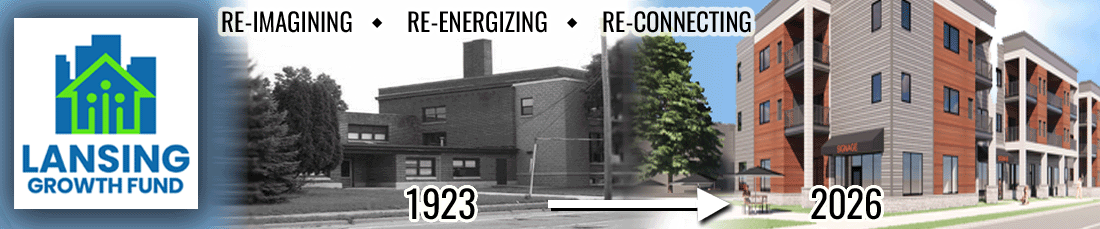


A
new chapter for Southwest Lansing is being written — one built by
the community, for the community.
The Lansing Growth Fund is a community investment fund that enables
everyone, regardless of wealth, to become an investor. The fund’s
focus is keeping capital working locally to support neighborhood-scale
development that strengthens Lansing over the long-term.
The Fund invests in real estate and community-based businesses, beginning
in Southwest Lansing and expanding thoughtfully across the Greater Lansing
region. Its purpose is simple: align investment capital with community
priorities so neighborhoods can grow in ways that are stable, inclusive,
and locally owned.
At the same time the fund is a wealth building tool allowing for those
living in the community to invest their money locally and see long term
growth in their household wealth. Keeping money in the local economy means
more dollars will be spent locally. This is the foundation of building
local economies that thrive.
At its core, the Lansing Growth Fund is not just about financing
projects. It is a long-term community capital platform—built to recycle
dollars locally, support multiple real estate and business investments
over time, and give local residents and mission-aligned investors a direct
role in shaping the future of Lansing’s neighborhoods.
Over time, the Lansing Growth Fund seeks to demonstrate that community-guided,
place-based investment can deliver both responsible financial performance
and lasting neighborhood benefit—helping ensure that the communities
doing the planning also have the tools to own the future they are building.
Too often, capital flowing into neighborhoods is disconnected from community priorities, focused on short-term returns, and controlled by decision-makers outside the community. This has made it difficult to finance neighborhood-scale projects that require long-term stewardship and alignment with local values. Profits leave. Control leaves. And the people who live in the neighborhood are left reacting to change instead of shaping it.
Community banks that once knew neighborhoods, financed local projects, and reinvested deposits locally have been consolidated into larger, centralized institutions. At the same time, the traditional growth model prioritized outward expansion and sprawl, pulling investment away from city cores and established neighborhoods. As capital and decision-making moved farther away, so did opportunity.
Many neighborhoods that thrived from the 1960s through the 1980s were left behind—not because they lost their strengths, but because investment followed highways, causing sprawl. As a culture, we built new instead of investing in the places where people lived. Over time, this pattern contributed to long-term disinvestment, weakened local ownership, and a shrinking ecosystem for neighborhood-scale investment.
In much of the country, there has been no strong local investment infrastructure to replace what was lost. Capital generated locally no longer stays local, reinforcing a cycle of scarcity: fewer investments led to fewer opportunities, making it even harder for communities to recover and grow.

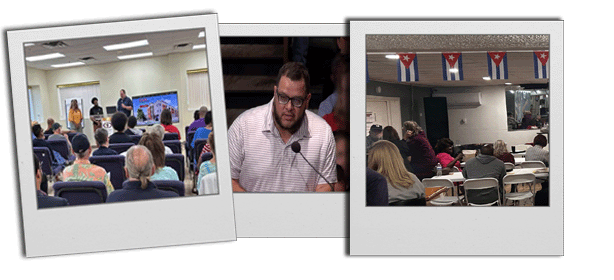
In 2016, residents of Southwest Lansing came together to build and begin executing the Southwest Action Plan—a community-led roadmap focused on creating stronger, healthier, and more connected neighborhoods. Since then, residents, neighborhood leaders, and local organizations have spent countless hours identifying what their community needs to thrive: stable housing, places to gather, access to services, a strong local business ecosystem, and opportunities that allow families to build long-term financial security.
All of these goals required a different approach to enable community decision-making on real estate and community business projects. Community members would have to be able to lead investments to the places and the priorities they wanted, not follow investment decisions made by others, in particular others outside the community.
The good news is that recent changes in federal securities laws and related rules offer the possibility of a new approach to community projects, including the creation of a locally controlled and invested pooled investment fund. This fund could be embedded in the community, governed by the community, and could drive investment in the community to match the community’s vision.
The Lansing Growth Fund is the culmination of the need to lead investment in SW Lansing, and the method that will combine local investment and other capital investments that are aligned with the community’s values and goals. Created utilizing a model known as a Diversified Community Investment Fund (DCIF), the community is now positioned to launch the first project the fund will invest in, at the corner of Holmes and Pleasant Grove Roads.
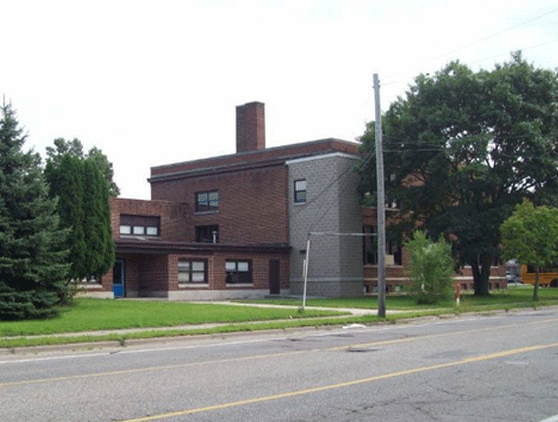
The Holmes and Pleasant Grove project will create a vibrant neighborhood community center in a historically significant site, attracting investment and opportunity to a parcel owned by the Ingham County Land Bank. When properties go to tax sale in Ingham County, some are held by the Land Bank until the right mission-based project comes forward—one that aligns with community goals and can create long-term value. The former Pleasant Grove and Holmes School was one of these properties.
Supported initially through a State grant and administered by the Ingham County Land Bank, both the project and the framework for the Fund are now moving forward. The National Coalition for Community Capital (NC3) brought in a team of experts from around the country to help co-create a DCIF. The CityCraft Foundation helped structure the system locally—ensuring that the work the community has done over the years becomes the foundation for how investments are made moving forward, centered on self-sustaining and lasting growth.
Through collaboration with development and construction partners, support from local banks and credit unions and strong partnership from the City, Ingham County through the Trust Fund, and State partners including MSHDA and MEDC, the Fund’s first investment is now being built.
Over the next year, community members will be able to see that project take shape—and have the opportunity to invest directly in it—so that the growth happening in Southwest Lansing is not only visible, but has the opportunity for those who live in the community to have ownership in how the community grows.


The fund structure follows best practices developed around the country to keep wealth local. The Fund provides a way for residents, mission-aligned investors, and partners to pool capital and invest in projects that strengthen neighborhood connections, improve stability, and build long-term community wealth and ownership.
In the Lansing Growth Fund, capital is raised locally from community members and those who want to support the community. The money is invested locally, and diversified over time across multiple community-aligned opportunities—such as real estate and local businesses. This diversification helps manage risk while supporting a broader neighborhood ecosystem.
A team of local experts in finance and investments, along with elected community investors, will manage the fund, meaning due diligence, underwriting, oversight, and reporting are handled at the fund level by a Board. This frees investors from having to evaluate individual projects.
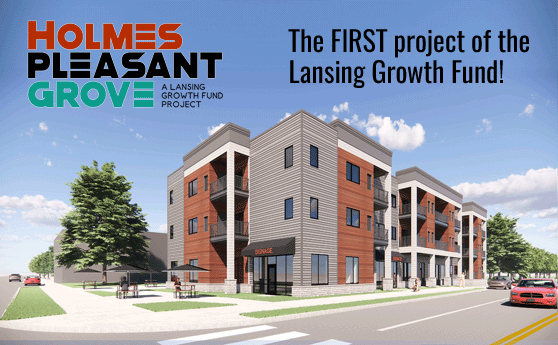
The Fund’s first investment, the Holmes & Pleasant Grove Neighborhood Center, is designed to reconnect this area with the features every community loves and deserves — places to gather, new housing options, and bringing banking services back to a neighborhood that hasn’t had a financial institution in years. Holmes & Pleasant Grove will be the first of many community real estate and local business projects where the people in the community help make it a reality. This project is about more than construction. It’s about restoring access, dignity, and opportunity — creating a place that truly reflects the people who live here. The project has advanced through planning, site control, and partnership formation, demonstrating that the Fund is not a theoretical concept but a vehicle tied to a real, executable investment.
The development expert brought in for the first project is Brent Forsberg, a professional with over 25 years of project experience in the Greater Lansing Area. In collaboration with the community team, his expertise in community based projects facilitated the Holmes & Pleasant Grove project through the local approval and finance process to get the project shovel ready for construction.
 "I
am so excited to have this Pleasant Grove and Holmes Rd. project come to
the south side of Lansing. When I first heard of this concept where the
community can have ownership in projects like Holmes & Pleasant Grove,
it was happening in other cities like Detroit and Muskegon.
"I
am so excited to have this Pleasant Grove and Holmes Rd. project come to
the south side of Lansing. When I first heard of this concept where the
community can have ownership in projects like Holmes & Pleasant Grove,
it was happening in other cities like Detroit and Muskegon. I was overwhelmed because I never thought that we would see this in Lansing. The concept of community involvement through its own investment, partnership with the developers - unheard of! Well, it’s here - right in our own part of this city of Lansing. The community has an opportunity to show its strength through ownership of a building that will be used as affordable housing, as well as commercial businesses. This will also be a community meeting place.
This will be yours, Lansing.
You are part owners. Let everyone show that this concept works. Let’s
make sure we take care of OUR investment, our new complex. It will be
our finest hour. This is only the beginning!
— Manuel Delgado, Jr., Community Activist

"Watching the land that once housed El Shabazz Elementary, a staple
that helped shape many young minds, now be revitalized to continue pouring
life back into this community means a lot.
As a person with deep ties to Southwest Lansing, I reflect on what this
community has meant to me. I think about the nearby music studio sessions
that helped keep me out of the streets, and the barbershops that served,
and still serve, as more than places to get cleaned up, but spaces of
conversation, healing, and connection.
Now, as an investor in real estate, here in Lansing, it feels good to know that energy, effort, and resources (like what we see with the Lansing Growth Fund) are being poured into continuing to uplift a community that has poured so much into so many of us.” — Everett Walker, Partner at Welcome Home Group

The Lansing Growth Fund is a new fund, but it is not starting from zero. It is built on years of community planning, active development work, and a team with deep experience delivering neighborhood-scale projects.
This work has been supported by many local organizations and stakeholders, which has been helping align community priorities, existing initiatives, and development efforts into a coordinated, regenerative approach in Southwest Lansing.
When the fund is established, the leadership will be made up of local investors and leaders in the community. This provides continuity, accountability, and alignment with the community-driven vision that shaped the Fund’s creation.
The initial Board includes two locally appointed members and the founder of CityCraft, ensuring that the Fund’s compliance, structure, and mission are in place during formation. As investors commit capital, governance transitions to a broader, investor-represented structure.
Four additional Board members, including representatives from neighborhood investors, will be elected by investors, creating a seven-member Board responsible for guiding investment decisions, oversight, and long-term stewardship of the Fund.
 Potential
investments will be evaluated not just on financial performance, but how
they reflect the values and priorities established through neighborhood
planning and support long-term stability rather than short-term financial
gain.
Potential
investments will be evaluated not just on financial performance, but how
they reflect the values and priorities established through neighborhood
planning and support long-term stability rather than short-term financial
gain. The Lansing Growth Fund will ensure that investment decisions are both responsible and rooted in the long-term health of Lansing’s neighborhoods by utilizing local expertise and a structured review process. An advisory group will help evaluate opportunities and provide recommendations to the Board, ensuring decisions are informed by on-the-ground knowledge and community context.
We don’t just look at how much money a project might make. We want to know if it actually helps the neighborhood. To do this, we use a checklist called the Five Capitals to make sure we are helping the community in every way possible:
• Financial – the flow of money and economic resources within a community
• Built – the physical infrastructure that shapes daily life, quality housing, buildings, and public spaces
• Social – the relationships, trust, and networks that connect people within a community
• Human – the knowledge, skills, health, and abilities of the people who live in a community
• Natural – the environmental systems that sustain life and support community well-being
The Fund’s first investment is the Holmes & Pleasant Grove Neighborhood Center — a 28-unit apartment building that will include a LAFCU local branch, the Stable Communities Foundation, and a food accelerator kitchen to support local entrepreneurship.
Funds raised will be used to:
• Strengthen the project’s capital structure by paying down construction and short-term financing
• Support long-term stability through permanent financing
• Position the project to generate consistent returns for both investors and the community
As the Fund grows, capital will also be deployed into:
• Additional neighborhood-serving real estate
• Local businesses that contribute to economic opportunity and community stability
A portion of funds will support the professional services required to responsibly manage the Fund, including:
• Accounting and financial reporting
• Compliance and administration
• Marketing and investor communication
 The
Lansing Growth Fund will generate revenue through:
The
Lansing Growth Fund will generate revenue through: • Operating income, such as rents from housing and commercial space; and
• Long-term asset appreciation as projects stabilize and neighborhoods strengthen
Over time, the Fund is expected to generate returns in the mid single digits while also delivering value that does not appear on a balance sheet—stronger neighborhoods, shared spaces, and increased local ownership.
If you believe that strong communities are built by the people who live in them, this is your opportunity to be part of that work. The Lansing Growth Fund was created to keep investment local, align growth with community values, and give residents a meaningful role in shaping the future of Lansing’s neighborhoods.
By participating, you’re not just investing capital—you’re helping create places to gather, live, and connect, while building long-term stability and opportunity in the community you call home.
Whether this is your first investment or you’ve invested before, your participation matters. Together, we can demonstrate that community-guided investment works—and that neighborhoods can grow in ways that are inclusive, resilient, and locally owned.
Join us. Invest locally. Help shape how your community grows.
1. How do investment funds work in general? Do I need to live in the building to be an investor?
No, the fund is open to people who live in the community, those who want to support the community, and businesses, stakeholders and organizations who want to support growth in Lansing.
2. What is the difference between the Holmes and Pleasant Grove project and a traditional residential co-operative?
The Lansing Growth Fund enables not only residents of the Holmes & Pleasant Grove project to be owners and investors, but anyone who wants to be part of the project may do so. Importantly, Lansing Growth Fund investors will also be able to invest in other real estate and business projects in coming years.
3. Does the community, not just investors, have a voice in how the fund invests?
The community can bring businesses and projects to the fund to consider for investment. The investors make sure that investments are aligned with community values. The final decision of what businesses and real estate is invested in is made by the investors through the investor board.
4. How will the legacy of Malcolm X be honored by this project?
The project will respectfully note the location of the site where Malcolm X attended elementary school. There is a committee of community members designing the memorial and working with the development team on how his story will be told.
5. Is it possible for investors to exit the fund?
Investments are not tradeable, but investors may be able to sell their shares to other interested community investors after the one-year holding period. If investors sell their shares, they can only buy back into the fund as part of another offering, and they will have to buy at the current share price, which may be more than the price of the original shares.
6. What kinds of investments may the fund make?
The fund will invest in the ownership of real estate projects and businesses, as well as make loans to real estate projects and businesses. The focus of the investments will be aligned with supporting local growth and wealth building in Lansing.
7. How will future funds be raised for the fund?
The fund will periodically go back to the community with other opportunities to invest, as well as seek philanthropic funding. Any capital raised by the fund will be aligned with the values of the fund.
8. Will community members who sit on the board receive support and training?
Yes. Building human capacity in the community is a fundamental mission of the fund under the five capitals.
9. What is LGF's commitment to sustainability and the environment?
The Fund supports
projects that embrace:
- Walkable Communities
- Renewable Energy
- Recycling/Composting
- Water Conservation
- Stormwater Management
For instance, at Holmes & Pleasant Grove, we're reintroducing
walkability by orienting buildings toward the street and expanding sidewalks
to 8 feet to promote pedestrian use. The project uses materials that
help reduce energy use such as Structure Insulated Panels for the walls,
and we're integrating stormwater infrastructure to heal the ecology.
By using green technologies and incorporating permeable surfaces we'll
reduce runoff into the Grand River.